 Falcon Pest Control
An integrated pest management program for Rice-Eccles Stadium — designed by a Board Certified Entomologist.
A pest management program for the South End Zone. Eight zones. 157 devices. Five specialty programs on biological calendars. A live operational portal accessible from Day 1.

Falcon Pest Control
What you are currently getting.
The photographs below were taken inside Rice-Eccles Stadium during recent walkthroughs. Each shows a different aspect of the pest control program currently in place at your facility. The diagnostic captions describe what a Board Certified Entomologist sees when looking at each image.
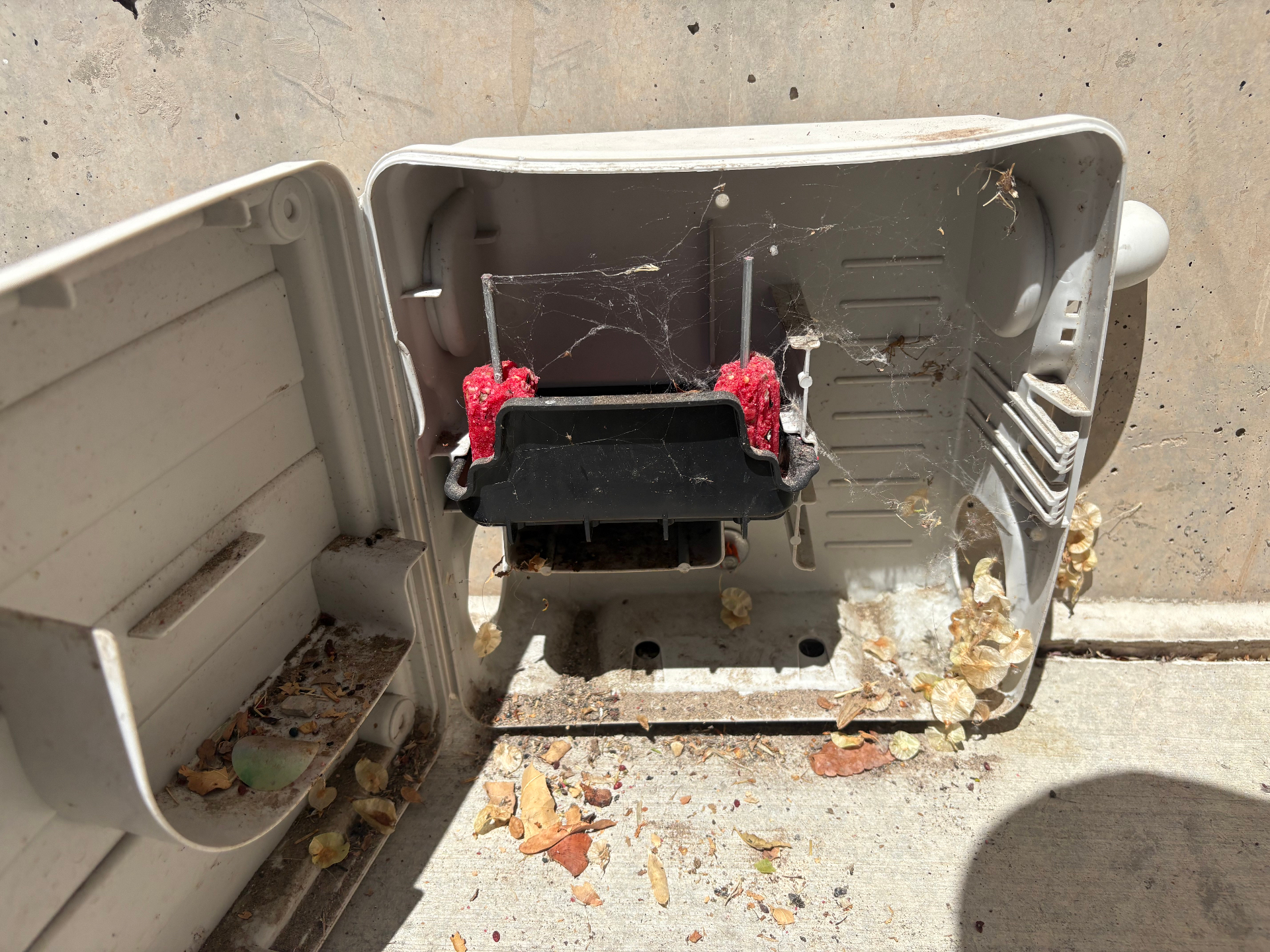
A bait station maintained at this level is a station rodents avoid. Rats and mice carry an evolved aversion to spiders — a venomous predator they recognize on instinct. A station with this much webbing is not a feeding station; it is an obstacle. With abundant food sources in the surrounding facility, no rodent will push through this to reach the bait inside.
The bait itself raises a separate question. The Pest Control Technology industry consensus is a four- to six-week bait change-out cadence on a "need-it-or-not" basis for general commercial accounts. AIB International requires monthly inspection minimums. BRCGS food safety standards require routine inspections at four-week intervals minimum. Under Utah summer climate exposure, fat oxidation in oil-formulated baits accelerates measurably with each 18°F temperature increment. There is no way to know, looking at this station, whether the bait inside has been replaced within any of those intervals — because the only service record for this device, if one exists, is held by the incumbent contractor. The Athletics Department has no independent record.
Under the Program proposed here, every device service is photographed, dated, and uploaded to a portal accessible to designated University stakeholders within 24 hours of the visit. Service intervals are documented against the cadence intervals required by recognized authorities. There will be no mystery about when a station was last opened, what was inside, or whether the bait is current. The record will be the University's, not the contractor's.
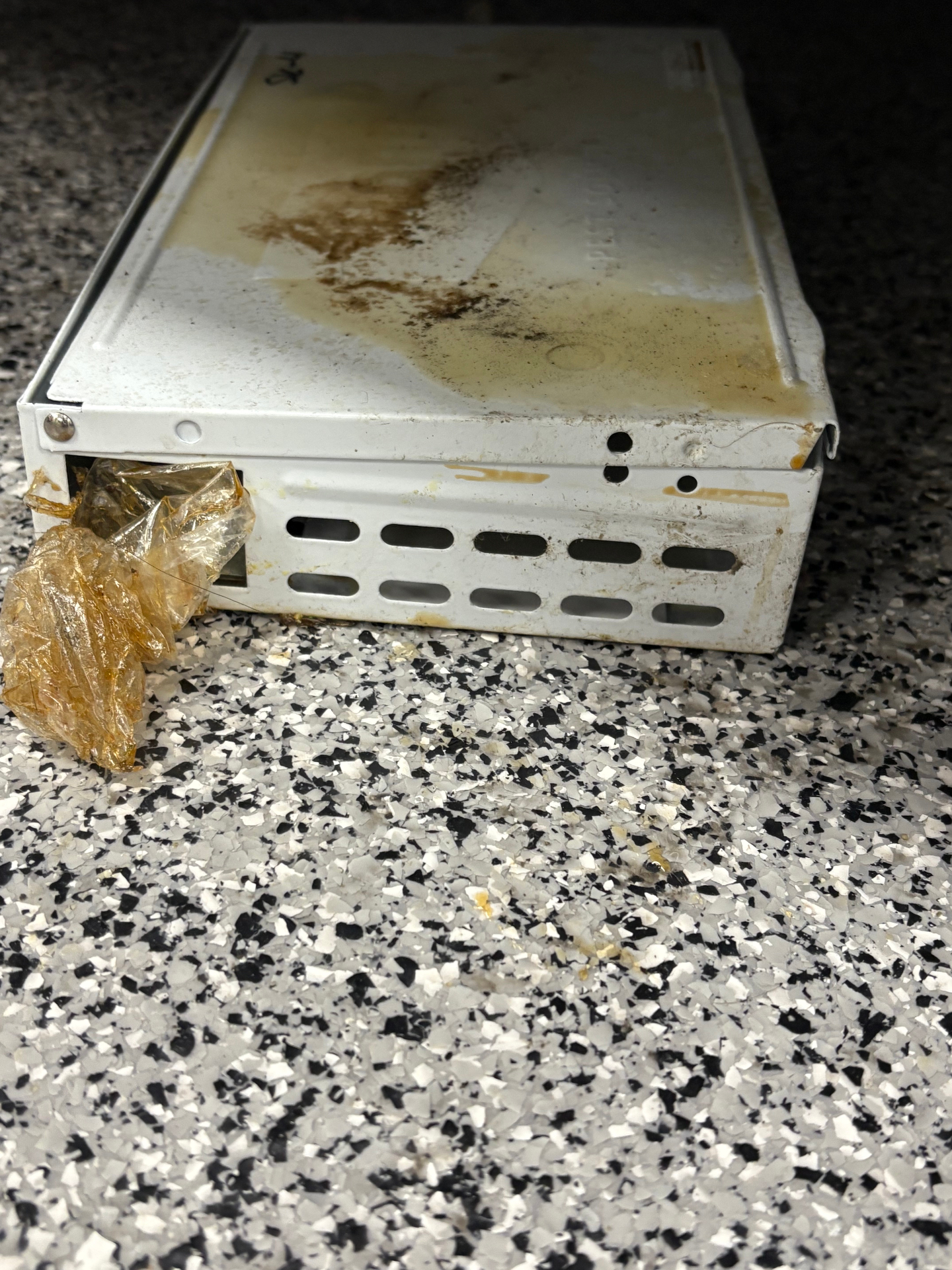
The entry to this multi-catch station is physically blocked by trash. Two interpretations are available: the station has not been opened in long enough that the obstruction was never noticed, or it has been opened and the technician declined to address it. Neither interpretation is acceptable.
A station of this kind requires three things to function: a clear entry path, fresh glue surface, and routine inspection. None are present here. The root cause is not technician error in isolation. It is the absence of quality assurance — no oversight, no audit, no management of the field technician's execution. The Program proposed for Rice-Eccles is built on the inverse principle. The Board Certified Entomologist signing this proposal previously served as Vice President of Operations and Senior Director of Quality Assurance for a national pest control company, with direct accountability for the QA architecture deployed across thousands of technicians and millions of service visits. That same discipline is what governs every Falcon visit at Rice-Eccles, every device serviced, every record uploaded.
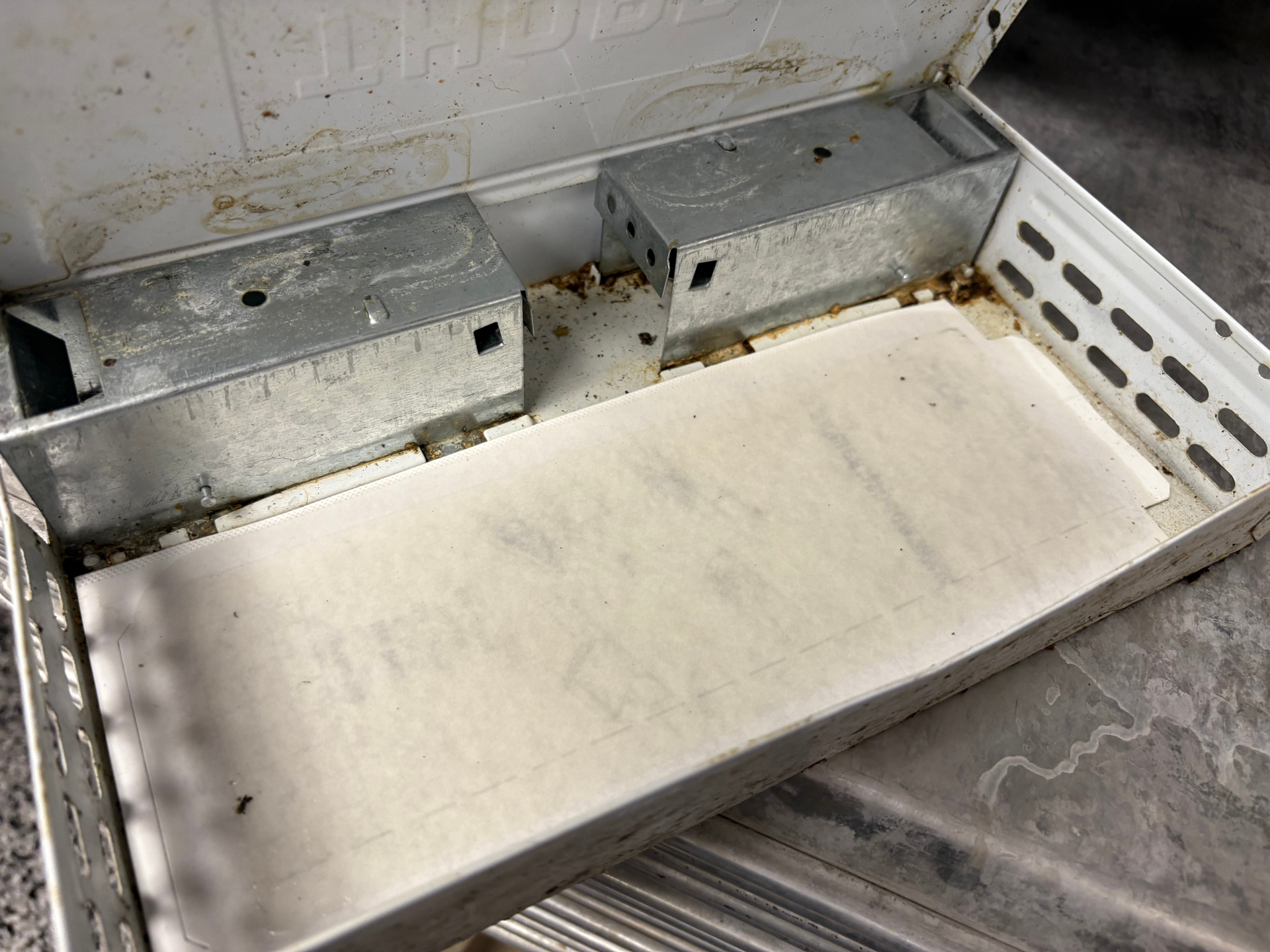

The glue board visible here has lost its tack entirely. Mechanically, that does not matter — this is a one-way multi-catch; once a mouse enters, it is captured regardless of glue surface. The problem is not the glue. The problem is the story the glue is telling.
A glue board this stale has not been replaced in many months. No one has opened this device to look inside. No one has logged what was found. The essential work of rodent management is not the trapping — it is the inspection. A trained specialist opens every device, records what is there, and feeds that data into a body of evidence that tells us where rodent activity is occurring in the building. Without that inspection, there is no rodent control program; there is only equipment placed against walls.
The Program proposed here is built around the work this photograph shows is missing. Every device opened on a defined cadence. Every finding photographed, dated, and uploaded to a portal accessible to the University within 24 hours. Every pattern surfaced into trend dashboards a Board Certified Entomologist reviews and signs. The trapping is the easy part. The discipline of inspection — every visit, every device, every time — is the difference between a rodent management program and a row of unmonitored boxes.
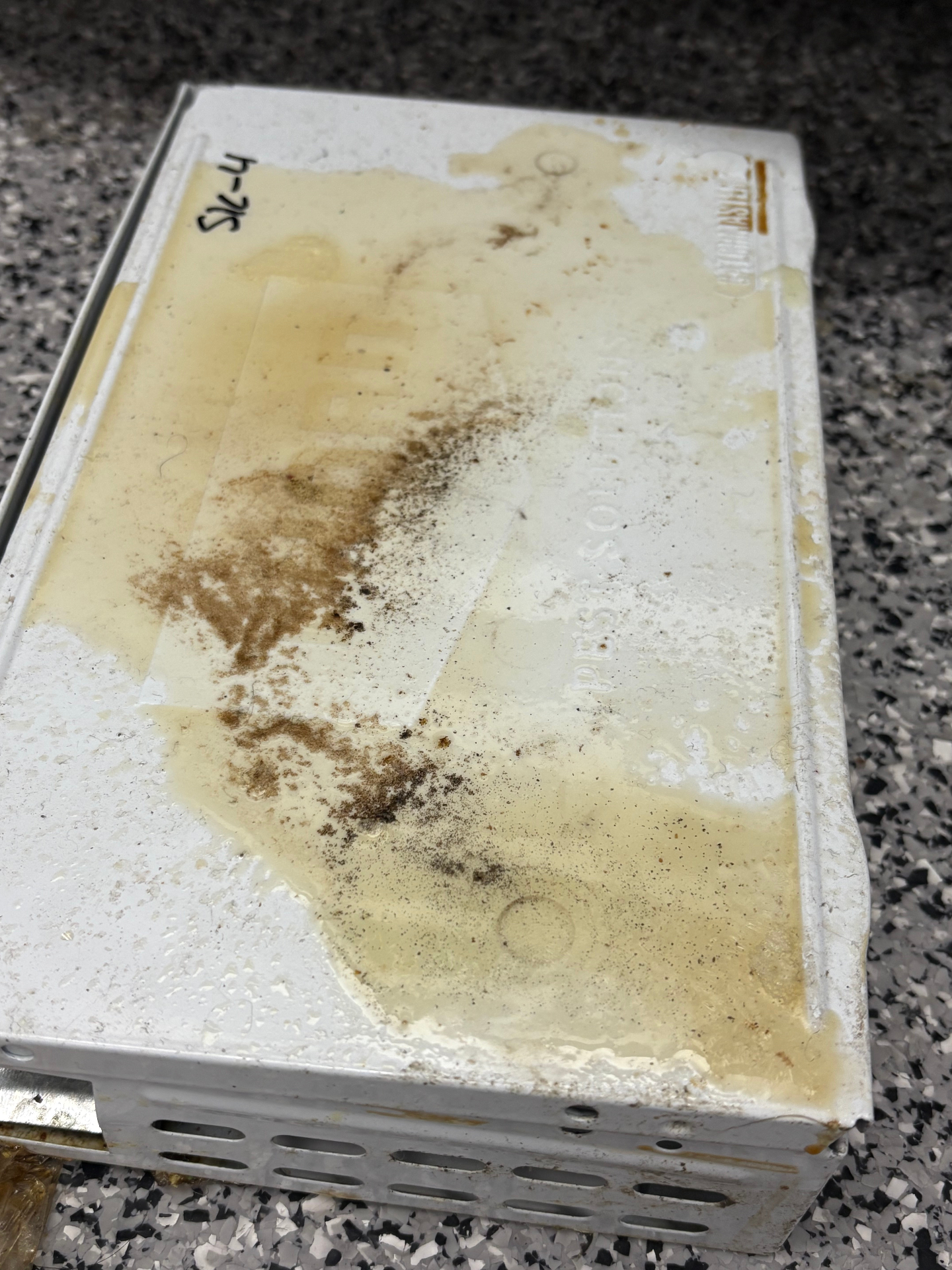
Contamination at this level converts the station from an attractant to a deterrent. Rodents avoid stations carrying the chemical signatures of mold, oxidized fats, and accumulated organic residue. This station has reached a state where its own condition prevents it from doing the work it was installed to do. Replacement of the consumable bait tray and cleaning of the housing is a routine task on a defensible service cadence — but only if the cadence is being followed.
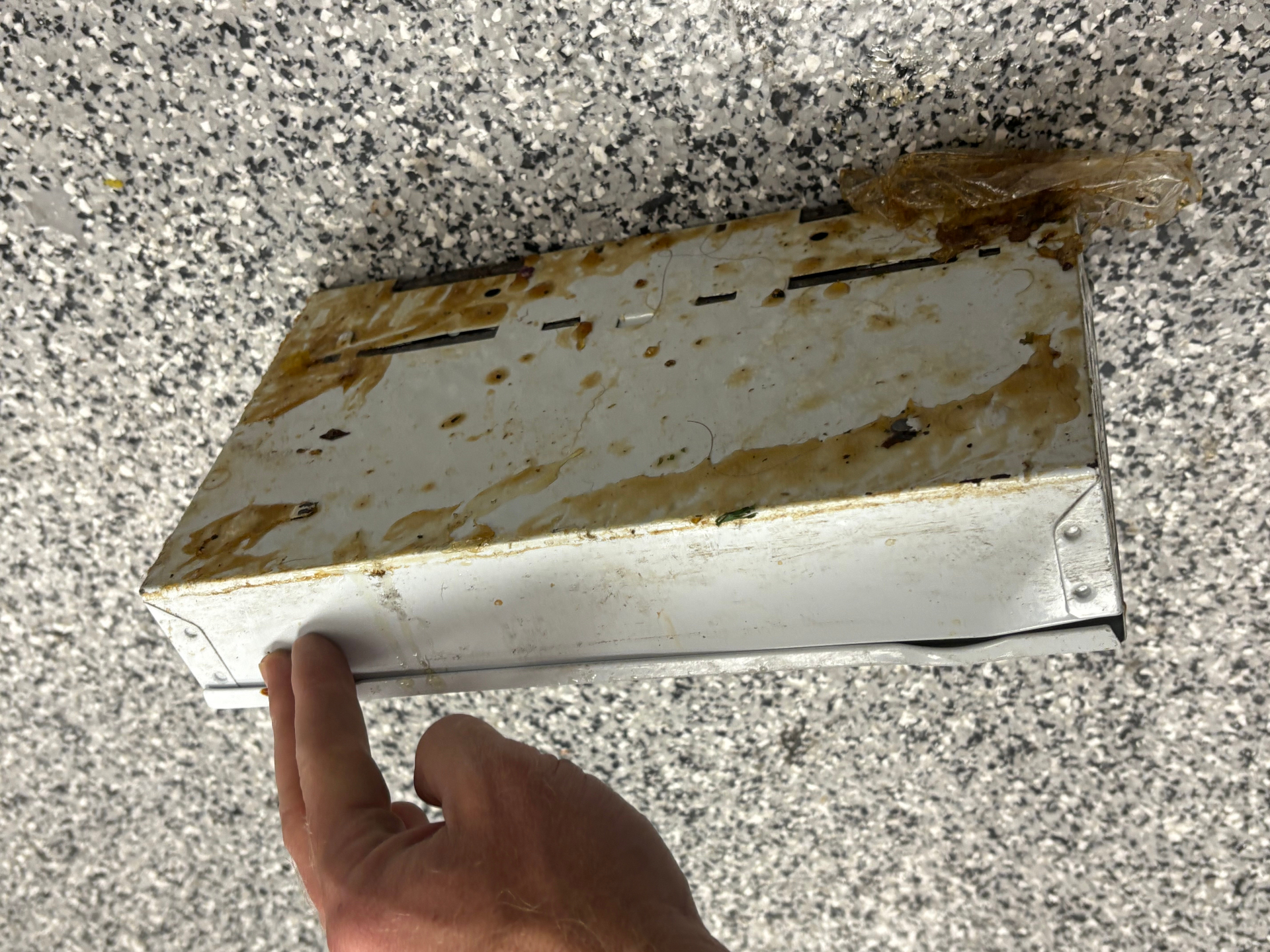
Spillage on the underside of a station is not, by itself, a finding. Active kitchens are messy by nature, and Athletics Department staff are already doing the difficult work of running a high-volume facility through event days. The question is not whether residue accumulates. The question is what residue at this level tells us about how long this station has gone untouched.
A station pulled, opened, and inspected on cadence does not reach this state. The conclusion that follows from this photograph is that this device has not been moved in months. The work the Athletics Department is paying for at this position is not happening.
It is reasonable to ask why this matters when no rodent activity has been observed. The answer is that the absence of activity is not evidence of pest control — it is evidence that other systems are working. The kitchen team's sanitation discipline. The facilities team's structural maintenance. The procurement team's standards for the building envelope. Pest control should be reinforcing those efforts. Right now, it is not contributing to them.
The Program proposed here puts a Board Certified Entomologist alongside the staff already maintaining this facility, not above them. Stations pulled and inspected on a defined cadence. Conducive observations photographed and shared with the facilities team as opportunities, not citations. Findings logged where they can be used — by the people who can act on them — before a food safety inspection or third-party audit raises them first. The rodent control program becomes part of the building's standards work, instead of a line item disconnected from it.
Why a Board Certified Entomologist.

A BCE is not a license. A license permits operation. A credential certifies expertise. The Board Certified Entomologist designation is awarded by the Entomological Society of America following four examinations, peer endorsement, and continuing education requirements that renew every three years. Fewer than 1,800 BCEs hold the credential nationally. None operate commercial pest control accounts in the Salt Lake metro area at this level. Until now.
Every protocol grounded in current entomological literature, not vendor convention.
A BCE signature carries audit defensibility under FIFRA, R68-7-13, AIB, and BRCGS.
A BCE can recommend reducing program scope without conflict of interest.
Pest identification, monitoring, and intervention follow ESA-defined IPM standards.
Trent Frazer holds a Master of Science in Entomology from the University of Florida and Board Certified Entomologist credential #B3413, awarded April 2025 with specialty in General Entomology.
Career arc spans top sales producer to operations leadership at Aptive Environmental, where he served as Senior Director of Quality Assurance overseeing a 7-person analytics team and the full stack of customer operations quality across thousands of service professionals serving hundreds of thousands of customers.
Falcon Pest Control was founded to bring BCE-grade entomological standards to commercial pest control accounts in Utah — accounts the existing market has been unable to serve at the level their facilities require.
What real pest control looks like.
The program described below was built specifically for Rice-Eccles Stadium following walkthroughs with University of Utah Operations leadership. The core scope is rodent control — rats and mice — designed and delivered with the rigor of a stadium-class IPM program. Eight canonical zones, with rodent monitoring and intervention as the load-bearing structure of every one of them. Specialty programs for cockroach, wasp, ant, boxelder/elm seed bug, and cluster fly run on biological calendars in parallel as included enhancements that sharpen the program. Eight KPIs measured continuously. Every device with a measurable purpose. Every visit producing verifiable data. Every quarterly review carrying a BCE signature.
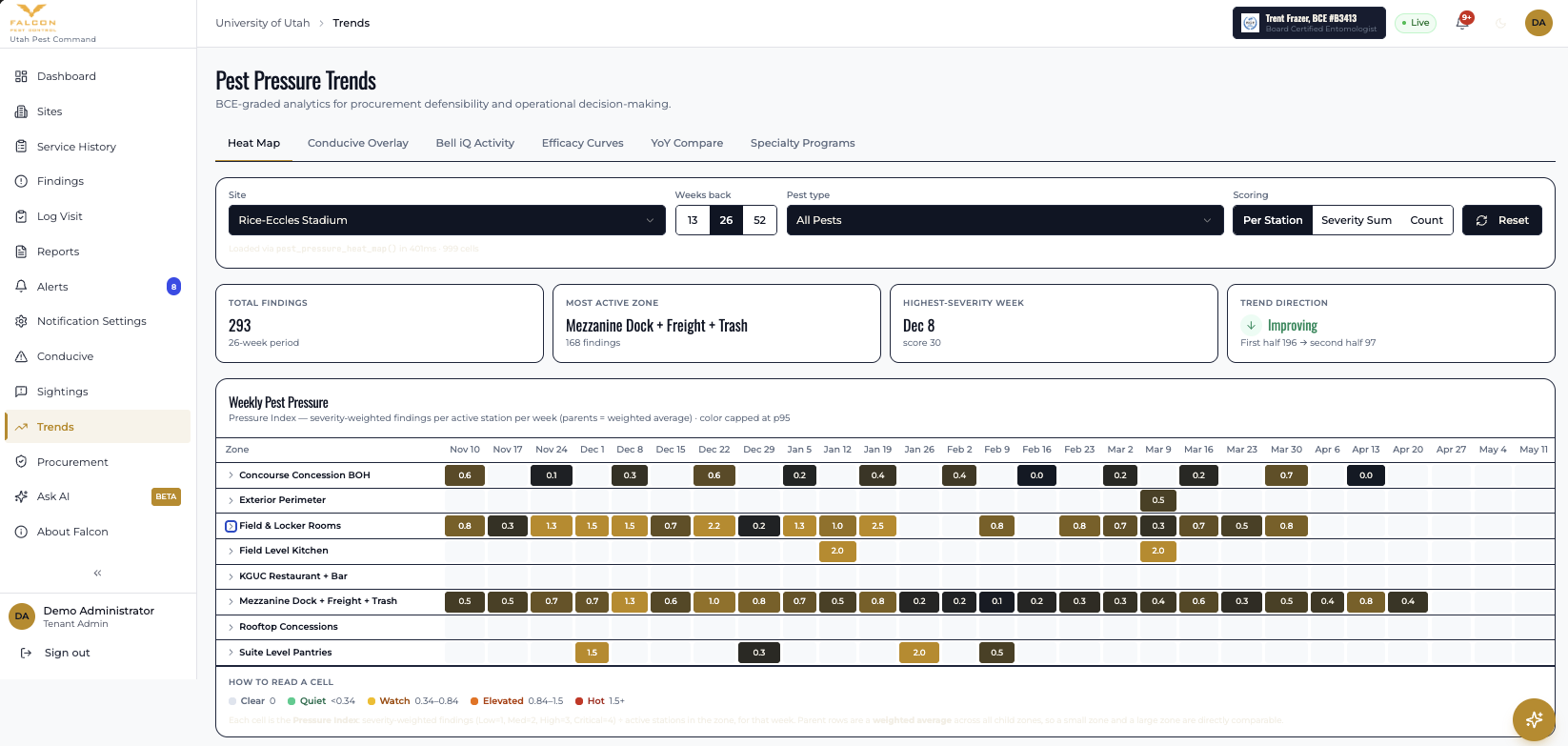
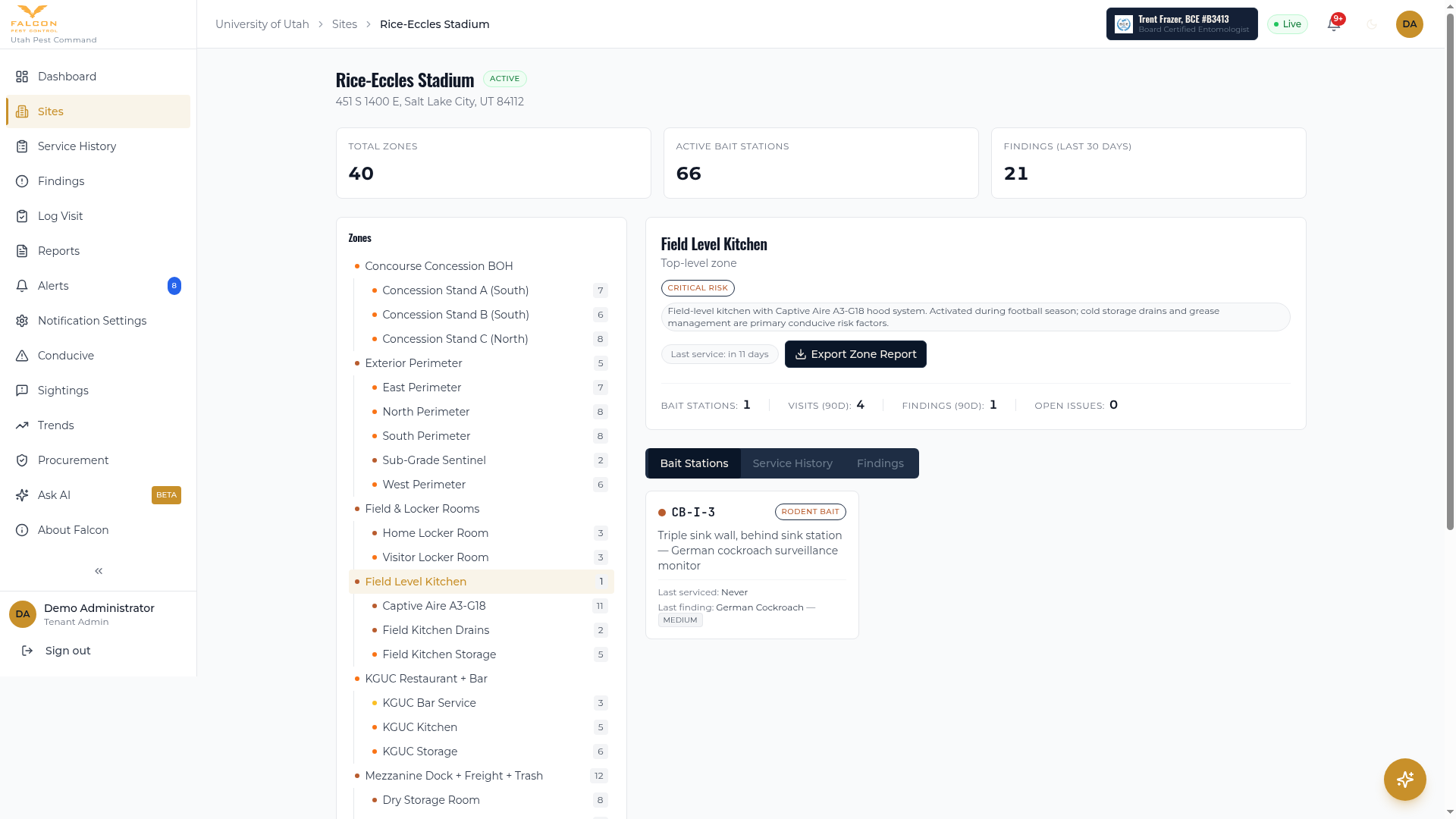
The kitchen, the locker rooms, and the pest pressure they create.
The Field Level houses the football team's commercial kitchen, the home and visiting locker rooms, the marshalling area, and the mechanical room. The kitchen runs on the football calendar — heaviest during training table and game weeks — but the locker rooms stay active year-round, which means pest pressure on this level never fully resets. It has to be perfect in-season and consistently maintained in the off-season.
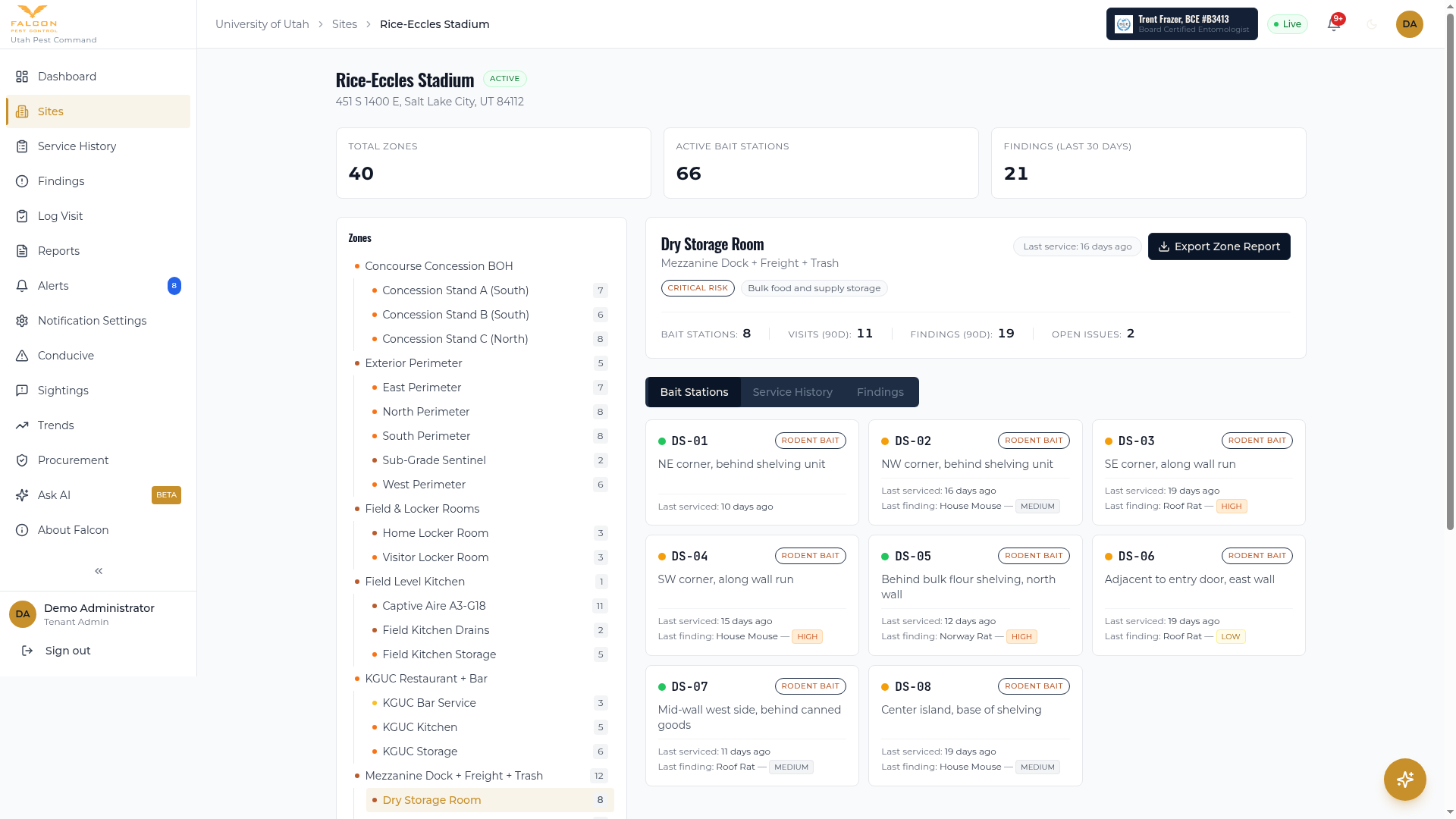
The dock. The corridor for everything that enters the building.
The Mezzanine Level is the ingress point for every food delivery, vendor shipment, and trash egress in the building. The loading dock area, freight elevator vestibule, and dock-adjacent storage create a continuous translocation corridor — every box that enters Rice-Eccles passes through this level. Pest pressure here is continuous, year-round, and disproportionately driven by what's coming in rather than what's already inside.
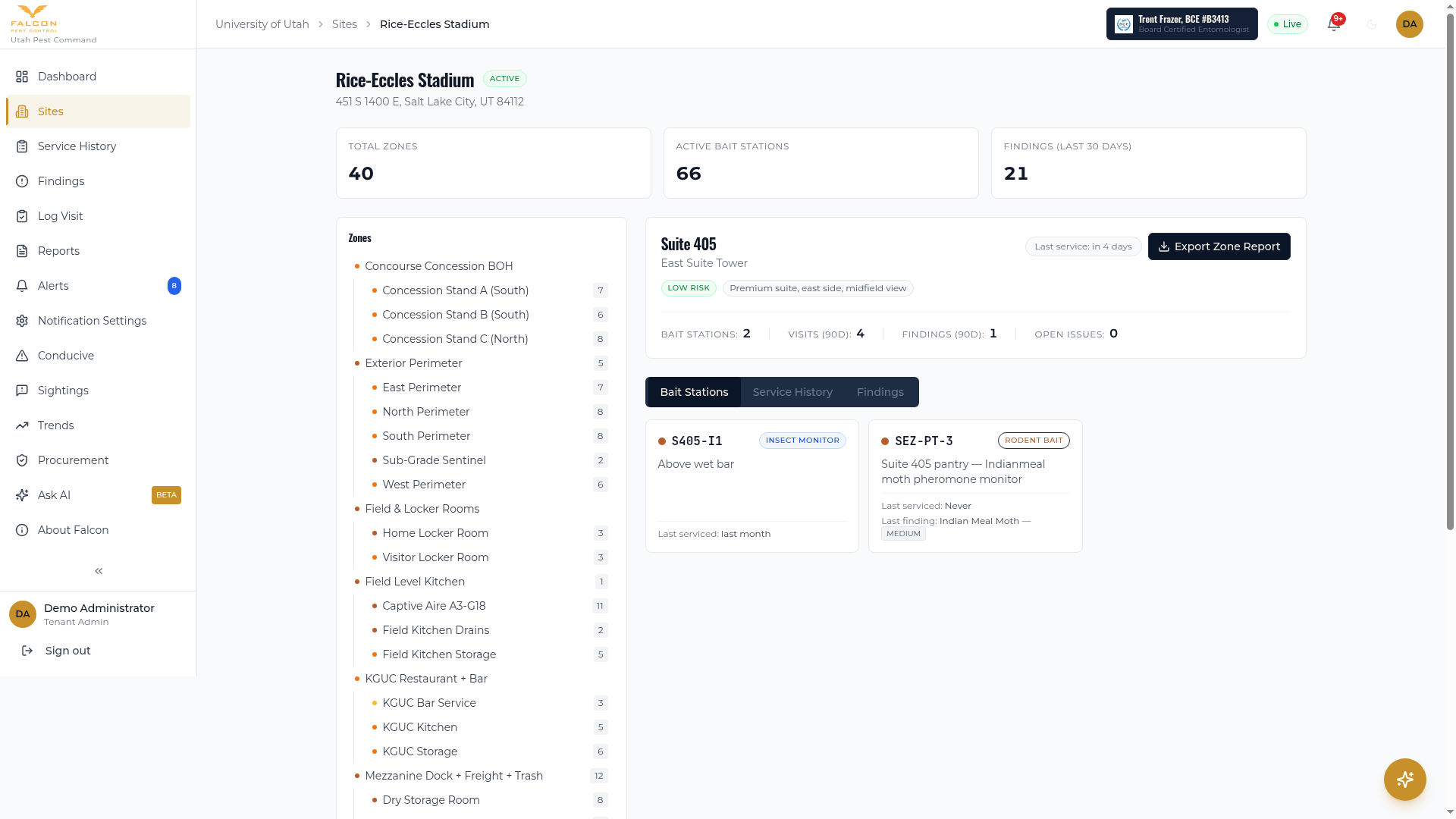
Fourteen suites. Two towers. A pantry network.
The SEZ Suite Level houses 14 premium suites across the south end zone, sharing pantry infrastructure, a lounge prep area, and suite-level mechanical and telecom. Year-round events drive intermittent food prep activity; football season concentrates use. Pest pressure here is moderate but the visibility risk is high — these are the customer-facing premium spaces of the stadium.
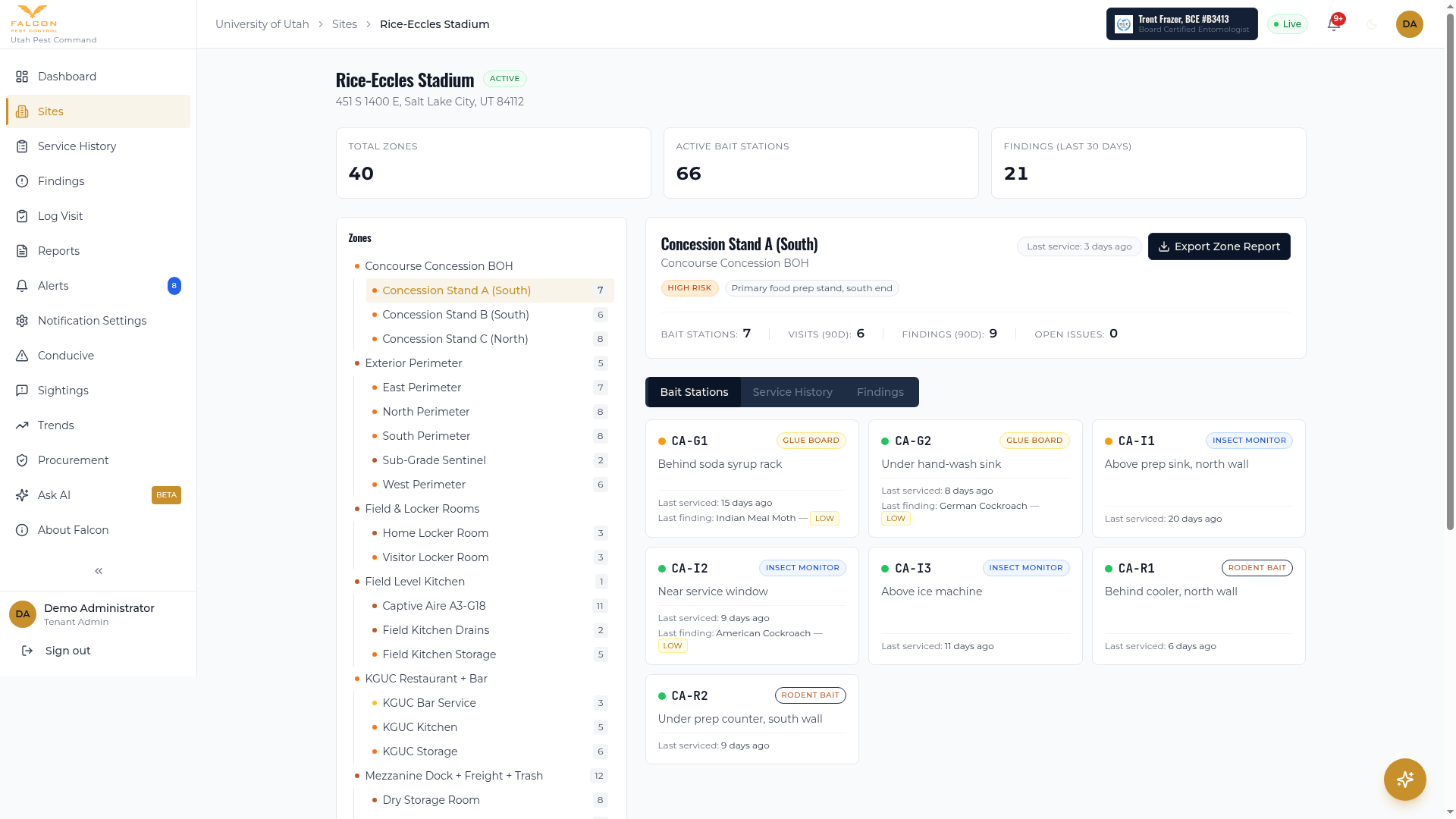
The concession spine. Three stands. One mezzanine ingress.
The Concourse Level hosts three concession stands running along the south concourse with associated storage and beverage rooms. Public restrooms, family rooms, and stair cores. During football, this is the highest-volume food service zone in the building — concession kitchens running at capacity for 5+ hours per home game with rapid turnover. Off-season, concourse is mostly idle except for recruiting events.
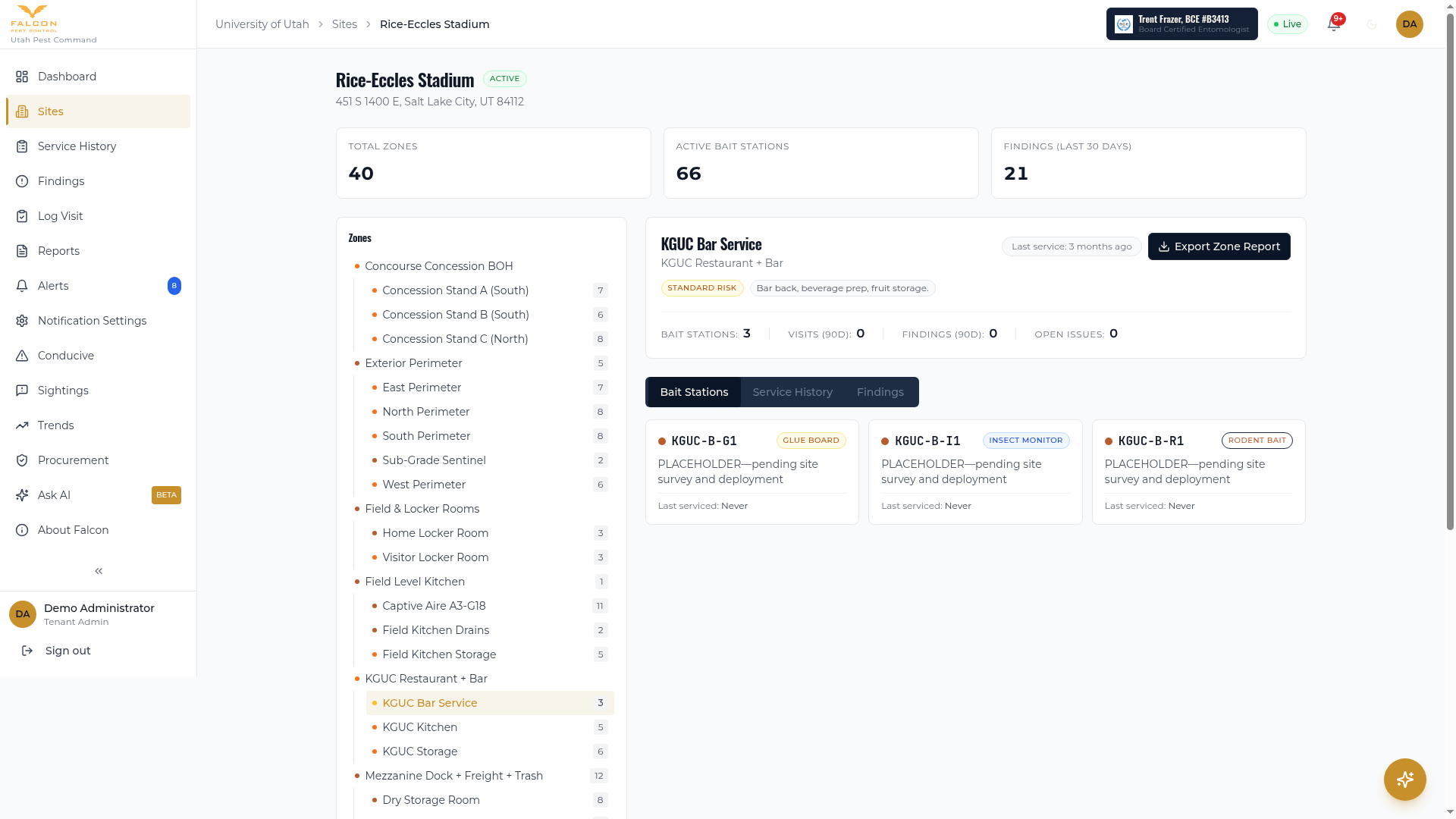
KGUC. The only campus liquor license. Three additional concessions.
The Rooftop Level houses KGUC Restaurant + Bar (year-round operation, only campus liquor license) along with three additional non-KGUC rooftop concession stands. KGUC operates as a steady-state food service environment year-round, requiring bi-weekly cadence regardless of football season. The other three rooftop concessions activate during football and major events. Pest pressure is concentrated at KGUC given its year-round food service; other rooftop zones see seasonal pulse.
Five biological calendars, layered on top of the rodent program.
The core scope at Rice-Eccles is rodent control, running every visit, every zone, every week. The five programs below are included enhancements that ride on biological calendars alongside the rodent work, sharpening the program's coverage at the moments of the year when specialty pests have leverage.
German, Oriental, and American cockroaches all present specific risk profiles at Rice-Eccles. 30 food-attractant cockroach monitors replaced monthly across all food zones. Posture A proactive response capacity — a rotation of professional-grade cockroach gel baits pre-stocked on truck and deployed at the next scheduled service visit. Drain biofilm treatment with a microbial bio-foam at all kitchen and dock floor drain positions. This is the program that prevents the operationally catastrophic outcome: a single cockroach sighting on the concourse during a televised event.
Eight KPIs. Continuous measurement. Visible to you in real time.
A year of pest control, mapped.
Falcon's recommendation, if entomological research were the only consideration, would be a uniform 14-day inspection-and-replacement cadence across every monitoring device at Rice-Eccles, year-round, with documented escalation to 7-day cadence during the 48 hours preceding each home football game and any major event drawing five thousand or more attendees. The science supports it. The Norway rat reproductive cycle — 21- to 23-day gestation, typically six to twelve pups per litter (Timm 1994; ICWDM), sexual maturity reached at approximately three months — means a new litter can be produced between inspections on a 30-day interval, and dramatically shorter inspection windows than the quarterly intervals seen in lower-tier commercial bids are warranted under sustained access. EPA-approved FIFRA labels for the rodenticide products proposed for use at the stadium direct users to "replace contaminated or spoiled bait immediately" (e.g., Contrac All-Weather Blox label, EPA Reg. No. 12455-79). Under Utah summer climate exposure, lipid oxidation rates in oil-formulated baits approximately double with each 10°C (~18°F) temperature increment (the Q10 rule), and rancidity is a documented cause of palatability loss in non-weatherized formulations — a risk elevated enough to warrant service intervals that allow inspection of bait condition between exposures. A 14-day cadence detects population establishment before reproductive maturity is reached rather than after it, builds a margin against bait degradation, and halves the trend-data interval available to the Board Certified Entomologist of record — doubling the resolution at which emerging activity can be identified at specific stations or zones.
Stadium-class environments warrant this cadence specifically because they combine four conditions that elevate rodent risk well above an ordinary commercial structure. First, an arid Wasatch foothill climate that concentrates rodent activity at the irrigated landscape edge. Second, a wildland interface that delivers deer mice, voles, and ground squirrels into the periphery on a year-round basis. Third, predictable food-waste pulses on event days, when a single home football game can introduce more concentrated organic waste into the facility envelope than a typical commercial account sees in a full quarter. Fourth, a hardened concrete and post-tensioned steel structure with extensive mechanical chases and structural voids that create harborage opportunities inaccessible to spot inspection. Each of these conditions, on its own, would justify above-baseline service cadence. Together, they require it.
Procurement reality, however, does not always permit the science-pure recommendation to be implemented as designed. The Athletics Department operates inside real budgetary constraints, and a uniform 14-day cadence applied to every zone — including lower-traffic areas like exterior perimeter stations and suite-level pantries — would substantially increase program cost without proportionally improving pest management outcomes. The Board Certified Entomologist signing this proposal also brings a career as Vice President of Operations for a national commercial pest control company — direct executive accountability for finding the balance between what the science demands and what the business permits. That dual perspective shaped the program presented here.
Falcon's program for Rice-Eccles applies the 14-day cadence where the research most clearly demands it: the highest-pressure, highest-consequence zones. The Field Level Kitchen, the Mezzanine Loading Dock, the Ken Garff University Club, and the Field & Locker Rooms all run on bi-weekly baseline cadence year-round, with weekly cadence during the September–November football pulse for the food-handling zones. The exterior perimeter, suite-level pantries, concourse concession back-of-house, and rooftop concession areas — zones with measurably lower baseline rodent and pest pressure during off-season operations — operate on a monthly cadence that escalates to bi-weekly or weekly during the football pulse, when use intensifies. This is not a uniform program. It is a calibrated program. Higher cadence is concentrated in the zones where pest pressure, food-handling risk, and event-day exposure are highest. Lower cadence applies to zones where the cost of additional visits would not produce a defensible return in pest management outcomes.
The result is a program that bridges both worlds. The science is honored where the science most clearly applies. The business reality is respected where additional cadence would be cost without commensurate pest management value.
The cadence calibration is the program's economic engineering. It is what allows BCE-grade rigor to fit inside a defensible institutional budget rather than requiring a budget that no procurement specialist would reasonably approve. A program that cannot be funded is not a program; it is a position paper. The proposal in front of you is a program.
If the proposal as presented does not fit the budget the Athletics Department has available, the right next step is not to put this work out for competitive bid against vendors who lack the credential to engineer scope responsibly. The right next step is a conversation. Tell me the budget. Tell me the priorities. As a Board Certified Entomologist with a parallel career in commercial pest management operations leadership, I can identify which components of this program are essential to pest management outcomes and which are optimization layers, then construct the right program for that budget while preserving its entomological integrity. The cadence calibration shown here is one example of that work. The same reasoning applies at any budget level the University can support. What changes is the scope. What does not change is the discipline of designing scope around evidence rather than around price pressure alone.
Every cadence decision in this proposal is documented, defensible against the authorities cited below, and signed by a Board Certified Entomologist who is personally accountable for the program's entomological integrity and for its operational sustainability inside the Athletics Department's budget.
Authorities supporting the cadence framework
- Bobby Corrigan, writing in Pest Control Technology magazine, the U.S. structural pest management industry's leading trade publication: recommends a four- to six-week bait change-out cadence "on a need-it-or-not basis" as standard practice for general commercial accounts. Stadium-class accounts with documented elevated risk warrant cadence below this floor in their highest-pressure zones.
- AIB International Consolidated Standards for Inspection (2023 update), Section 4.0 Integrated Pest Management: requires a written IPM program, an annual facility assessment, and at-least-quarterly pest-activity trend review (4.7.1.6), with the inspection scoring framework structured around monthly self-inspections. Risk assessment for an event-driven facility with wildland interface supports tighter than monthly cadence in food-handling and high-pressure zones.
- BRCGS Global Standard for Food Safety, Issue 9, Section 4.14: requires inspection frequency determined by risk assessment and documented, with at minimum an annual in-depth pest management expert review. The companion BRC Best Practice Guideline — Pest Control (2008) recommends routine inspections at a four-week minimum as typical industry practice, with biologist visits typically quarterly to biannually.
- NPMA Pest Management Standards for Food Processing and Handling Facilities (2016): a results-oriented framework based on trends, inspection, and observations rather than prescriptive frequencies, with baseline service recommendations provided where historical data is unavailable. Concession and suite-level food preparation zones at Rice-Eccles fall within this framework during event operation, and the Program escalates these zones during the football pulse based on trend data.
- FDA Food Safety Modernization Act, 21 CFR Part 117 Subpart B (Current Good Manufacturing Practice), §117.35(c): requires effective pest exclusion measures in food-handling areas, with documented preventive controls and records requirements addressed in Subparts C and F.
- EPA Risk Mitigation Decision (2008) and Proposed Interim Decisions (2022) for rodenticides: establish a stewardship framework for rodenticides — including tamper-resistant bait station requirements, restricted-use classifications, and carcass search/collection/disposal — that emphasizes documented professional oversight.
- University of Missouri Extension Publication G9444 (Pierce, reviewed 2022), adapted from University of Nebraska NebGuide G82-624 (Robert Timm, then-Extension Vertebrate Pest Specialist, 1982): biweekly-to-monthly inspection and replacement for permanent bait station programs, with explicit direction that "if the bait becomes moldy, musty, soiled or insect-infested, empty the box, clean it and refill with fresh bait."
- Mallis Handbook of Pest Control, 11th Edition (2025), Rats and Mice chapter: maintenance baiting guidance for high-pressure commensal rodent environments emphasizes shortened inspection intervals, consistent with the 14- to 30-day cadence reflected in MU G9444 and PCT industry guidance.
- EPA-approved FIFRA product labels for the rodenticides and monitoring blocks proposed in this bid (e.g., Bell Labs Contrac All-Weather Blox, EPA Reg. No. 12455-79): direct users to "replace contaminated or spoiled bait immediately."
The cadence schedule presented in this proposal is not a sales decision; it is the calibrated service interval for a stadium-class environment of this risk profile, designed by a Board Certified Entomologist with executive operational experience and signed under his professional credential.
That is the program in summary — a rodent control operation built to stadium standard, with specialty pest programs layered on top as included enhancements. The next section describes how it operates — the rhythm, the conducive condition workflow, the regulatory compliance documentation. The architecture of execution.
The rhythm.
Pest pressure does not operate on a calendar of human convenience. It operates on biological calendars — temperature, photoperiod, food availability, reproductive cycles, weather events. Falcon's service cadence aligns with biology, not with billing cycles.
Below is the complete year-one service calendar — every visit Falcon will perform under this contract, organized month by month and tied to the seasonal biology that drives it. The bi-weekly baseline runs continuously through all twelve months; football-week protocols, wasp protocols, and quarterly BCE audits layer on top in their respective seasons. Every visit is performed on-site by Trent Frazer, BCE.
Norway and roof rats push indoors for warmth and harborage. Bi-weekly interior + perimeter sweeps with rodent station rotation and SGAR replacement per FIFRA label.
- Jan 7Routine baselineInterior rodent stations + dock perimeter — full rotation
- Jan 21Routine baselineField Kitchen + KGUC + Mezz Dock — food-zone monitor service
Sustained rodent pressure; German cockroach reproduction continues year-round indoors. Drain biofilm treatment at all kitchen and dock floor drains.
- Feb 4Routine baselineAll eight zones — full perimeter sweep
- Feb 18Routine baselineFood zones — food-attractant monitor swap, drain biofilm treatment FS-1 → FS-5
Soil temperatures cross the 50°F threshold; overwintered wasp queens leave hibernacula and begin nest founding. Boxelder bug aggregations break apart. First wasp inspection establishes baseline.
- Mar 4Routine baselineInterior + dock — bi-weekly rotation
- Mar 11Quarterly BCE auditQ1 BCE audit — KPI scorecard, trend review with UU Operations
- Mar 18Routine baselineFood zones — monitor swap + conducive walk
- Mar 25Routine baselineInitial wasp inspection — soffit, fascia, light fixtures · boxelder baseline
Ant foraging trails establish along expansion joints; spider activity rises; first wasp nests reach golf-ball size. Exterior crack-and-crevice work begins.
- Apr 8Routine baselineExterior perimeter — ant trail mapping, crack & crevice treatment
- Apr 22Routine baselineRooftop + concourse — early wasp nest knock-downs
Wasp colonies enter exponential growth; stored-product pest activity rises in dry-goods storage. Targeted nest removal at structural positions.
- May 6Routine baselineInterior + storage — stored-product monitor service
- May 20Routine baselineSoffit + fascia — wasp nest sweep, residual rotation at exterior nest sites
Filth-fly and fruit-fly populations peak as temperatures hold above 75°F. Drain biofilm sources eliminated; LED insect light traps audited and bulbs rotated.
- Jun 3Routine baselineFood zones — fruit-fly drain treatment, LED ILT bulb rotation
- Jun 10Quarterly BCE auditQ2 BCE audit — mid-year KPI roll, BRCGS-aligned documentation review
- Jun 17Routine baselineExterior perimeter — ant + spider treatment
- Jun 24Routine baselineWasp mid-season structural check — soffit, signage tower, KGUC patio
Drain fly and fruit fly pressure at maximum; cockroach metabolism elevated, populations expand fastest. Q10 lipid-oxidation risk in monitor adhesives — monthly food-attractant monitor replacement non-negotiable.
- Jul 8Routine baselineFood zones — full monitor replacement (heat-degraded attractants)
- Jul 22Routine baselineDrain biofilm re-treat + interior cockroach gel rotation
Wasp colonies near peak size; spectator-zone risk highest. T-7 protocol gives dispersing foragers a full week to die off or relocate before opening kickoff.
- Aug 5Routine baselineAll zones — bi-weekly rotation
- Aug 19Routine baselineStadium bowl + concourse — pre-season conducive sweep
- Aug 27T-7 wasp protocolT-7 walkthrough — Thu Sep 3 Idaho opener · structural nest knock-downs, residual rotation
Game-week cadence layers on top of bi-weekly baseline: T-48 verification 48 hours before kickoff, post-game Monday resets, Q3 BCE audit on-cycle.
- Sep 1T-48 Friday verificationT-48 verification (Tue) — Thu Sep 3 Idaho opener · gate-open clearance log
- Sep 9Quarterly BCE auditQ3 BCE audit — pre-conference KPI review
- Sep 14Football MondayFootball Monday — post-Arkansas reset · concession drain treatment
- Sep 18T-48 Friday verificationT-48 verification (Fri) — Sat Sep 19 Utah State · suite pantry sweep
- Sep 28Football MondayFootball Monday — post-game concourse reset
Cluster flies and overwintering true bugs begin congregating on south and west elevations. Rooftop mechanical room ILT audit. Game-week T-48 / Monday reset cadence continues.
- Oct 2T-48 Friday verificationT-48 verification (Fri) — Sat Oct 3 home game
- Oct 5Football MondayFootball Monday — post-game reset · cluster fly perimeter check
- Oct 16T-48 Friday verificationT-48 verification (Fri) — Sat Oct 17 home game
- Oct 26Football MondayFootball Monday — post-Houston reset · rooftop ILT audit
Falling temperatures push rats and mice to interior harborage — exterior bait take rises sharply. Final two home-game cycles close out football cadence.
- Nov 6T-48 Friday verificationT-48 verification (Fri) — Sat Nov 7 home game
- Nov 9Football MondayFootball Monday — post-game reset
- Nov 20Routine baselineInterior rodent stations — winter-pressure rotation, exterior bait audit
- Nov 23Football MondayFootball Monday — post-final home game reset
Rodent indoor pressure at annual peak; cockroach activity continues in heated food zones. Annual KPI roll-up and R68-7-13 export package generated for UU records.
- Dec 2Routine baselineFull facility — interior + perimeter winter sweep
- Dec 9Quarterly BCE auditQ4 BCE audit — annual KPI roll-up, R68-7-13 export package
- Dec 16Routine baselineFood zones — year-end monitor swap, drain biofilm treatment
The wasp protocol.
Vespula and Polistes wasps build concealed nests May–October directly inside premium seating — underneath the fixed tray-tables and along the underside of the chairback shelves at the field-level chairback and loge sections, plus comparable cavities at KGUC patio seating. Disturbed mid-game, those nests sting the highest-paying donors and their families in their seats. The protocol below prevents it.
Conducive condition documentation.
A conducive condition is anything in the building that increases pest risk — a gap under a door, missing weatherstripping, a leaking pipe, a sanitation lapse. Falcon's accountability is documentation. UU Facilities owns the remediation decision. The workflow below ensures nothing falls through the cracks.
- 01Observation during visit
Tech identifies a condition that increases pest risk.
- 02Photographed + location-tagged
Visual evidence captured and tagged to a named on-site location so it can be found and addressed.
- 03Documented in portal within 24 hours
Written record with location, severity context, and recommended action.
- 04Severity-classified
Minor · Moderate · Significant · Critical.
- 05Push notification to designated UU stakeholderUU ↔ Falcon boundary
Severity moderate or higher routes to facilities contact in real time.
- 06UU Facilities owns remediation decision
Falcon documents. UU directs. The boundary is intentional.
- 07Status trackedUU ↔ Falcon boundary
In progress · Resolved · Declined — every disposition captured.
- 08Aggregated to quarterly review
Chronic conducive areas flagged for structural action by the BCE.
Regulatory compliance, captured live.
Utah Administrative Code R68-7-13 requires specific records for every pesticide application: product name, EPA registration, active ingredient, concentration, application rate, target pest, applicator license, location, weather conditions, re-entry interval. These records exist for every Falcon application. They are captured live during the visit and exportable to UDAF on demand.
- Visit
- Routine bi-weekly (March 11, 2026)
- Location
- Field Level Kitchen — drain at floor sink FS-3
- Target pest
- Oriental cockroach (Blatta orientalis)
- Product
- Microbial drain bio-foam
- EPA Registration
- On file — supplied with service record
- Active ingredient
- Microbe blend (citrus oil + microorganisms)
- Concentration
- Ready-to-use
- Application rate
- 2 oz per drain, foam expansion
- Applicator
- Trent Frazer
- License
- UDAF #4001-16378
- Weather
- Indoor, ambient 68°F, no wind exposure
- Re-entry interval
- None (non-pesticidal classification)
That is how we operate. The next section shows where you operate it from — your portal, live and always available, BCE-graded across every dimension this proposal describes.
University Pest Command.
The University of Utah's campus-wide pest intelligence platform.
What follows is not a stadium portal. It is the first deployment of a campus-wide pest intelligence platform built specifically for the University of Utah.
Rice-Eccles Stadium is the launch zone. Every additional University facility brought under Falcon's integrated pest management program is added to the same portal — Athletics, Housing & Residential Education, Health Sciences, Auxiliary Services, Dining, Research, the Union, the libraries, the museums. As the campus footprint grows inside the platform, the analytics grow with it. Pest pressure trends across buildings. Seasonal migrations between facilities. Conducive condition patterns surfaced campus-wide. A single Board Certified Entomologist signature across every report, every audit package, every regulatory record.
For the Athletics Department, this means the Rice-Eccles program is not a standalone vendor relationship. It is the founding tenant of an institutional asset the University builds equity in over time. Every dollar invested at Rice-Eccles compounds as the platform extends.
The screens below are live captures of the portal you receive at contract activation. Real-time pest data. Eight KPIs measured continuously. Trend analysis your incumbent has never delivered. An AI assistant trained on your facility's pest history. Regulator-ready reporting, one click away. This is what you control from Day 1.
One platform. Every stakeholder. Role-scoped access.
University Pest Command is not a vendor dashboard with one login. It is institutional infrastructure with role-based access engineered for how a research university actually operates. Five access tiers, each with a permission scope, dashboard surface, and notification routing designed for the role.
Read-only campus-wide. KPI dashboards, audit-readiness status, budget validation, regulatory compliance summaries. For the Athletics Director, Provost, CFO, VP of Auxiliary Services. No drill-down required — executive sightline only.
Read plus operational drill-down within their facilities. Trend analysis, conducive condition history, service visit records, pesticide application logs. Authorizes remediation decisions and responds to BCE recommendations.
Read within their assigned facility. Submit service requests, log sightings, subscribe to notifications for their zones. Kitchen managers, dining service supervisors, housing area coordinators.
Submit-only, mobile-first. A simple “Report a sighting” interface for janitorial staff, concession workers, custodial teams, and student employees. Photograph, location, two taps — the eyes and ears of the campus.
Full read-write platform access. The BCE signs deliverables; Falcon technicians log visits, conducive observations, pesticide applications. Internal Falcon staff only — and the only tier with write access to the pest management record itself.
Every tier connects to the same Board Certified Entomologist. Tier 4 frontline reporters submit sightings that route directly into the BCE's review queue. Tier 1 executives can request a 15-minute briefing from the BCE through the platform with one click. The platform is the connective tissue. The credential is the spine.
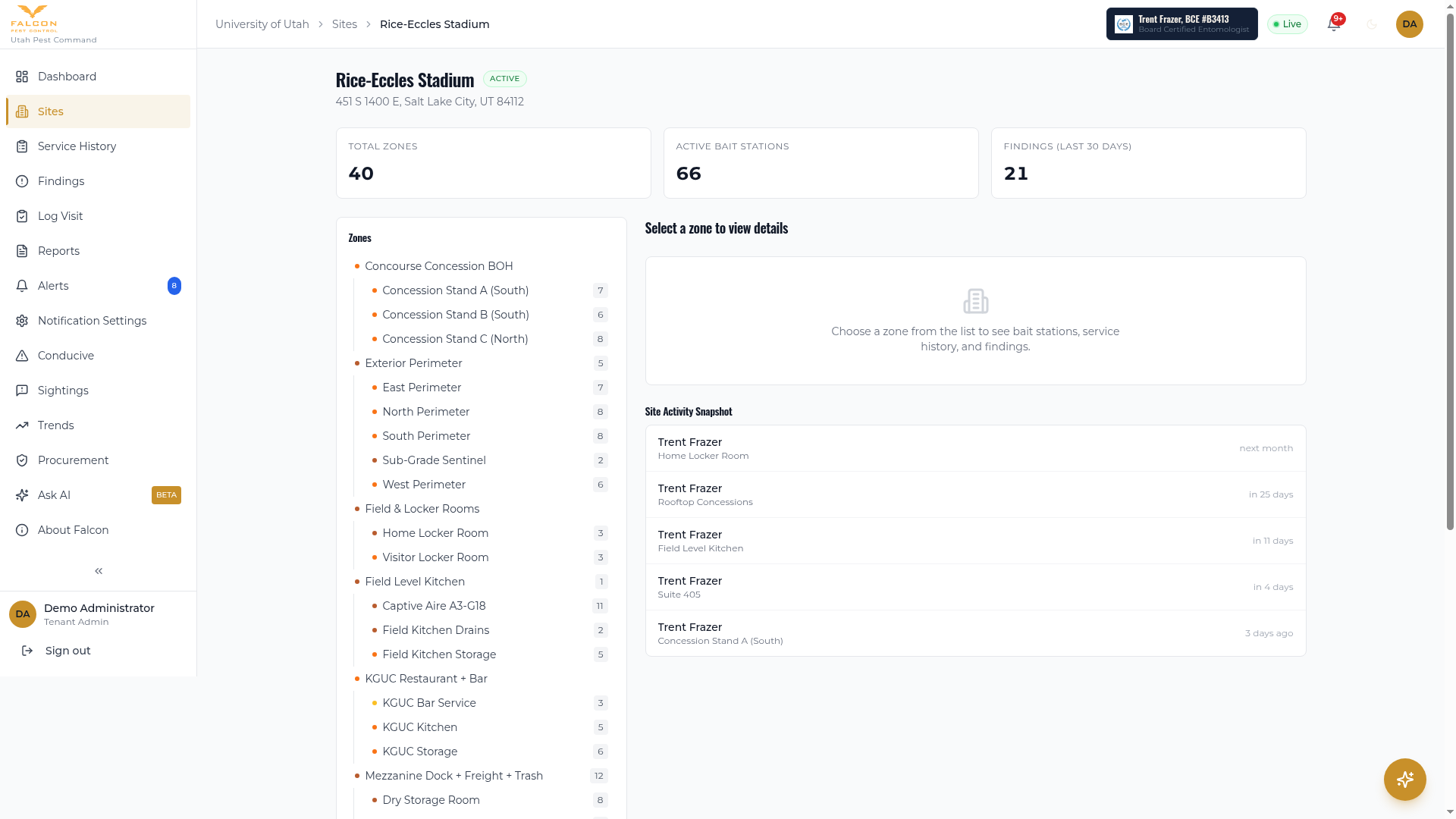
The Rice-Eccles site page — full zone tree (40 zones, 66 active stations), recent service activity, and one-click drill into any locker room, concession stand, or dock to see device-level history. This is your stadium, in the portal, today.
Open this view in the portalAlways-live data
Visit-cadence sync with IoT sensor devices. Real-time BCE narrative published on every quarterly review. Push notifications for severity-critical events. The portal is live the moment the contract activates.
Audit-ready, on demand
Monthly, quarterly, and incident reports generated, delivered, and tracked through the portal. Bundled audit packages — device inventory, service history, pesticide applications, conducive log, BCE attestation — available on request. R68-7-13 / FIFRA / R392-200-18 compliant records archived indefinitely.
AI-augmented intelligence
Vector-embedded RAG across all program data. Natural-language interrogation with cited sources. BCE-tone responses calibrated for executive briefings. Available 24/7, accessible to every authorized stakeholder.
The portal is not an add-on. It is included in the program described above. Every feature shown is operational at contract activation.
The next section describes what the program costs.
What perfection costs.
The number below is the full cost of the program described in this proposal — no trimming, no compromises, no scope reductions. Every protocol grounded in research. Every device with a measurable purpose. Every visit producing verifiable data. Every quarterly review carrying a BCE signature. Every component listed transparently.
This number is your anchor. The next section gives you the controls to right-size it if your budget requires.
A BCE-designed program. A BCE-led implementation. A BCE-signed monthly review. Every dollar accounted for. Every dollar defensible.
Hover any underlined line for detail.
That is what perfection costs. The next section describes how to right-size it if your budget is different — and how a BCE leads that conversation differently from how a sales representative would.
The proposal stands. If your budget doesn't fit it, the conversation does.
The program described in this proposal is what Rice-Eccles Stadium needs. Every component is defensible. Every cadence is calibrated. Every dollar reflects work that a Board Certified Entomologist will sign for and stand behind.
Budgets are not always what the work requires them to be. Procurement realities at large institutions sometimes mean the right program at the right price is still outside the available envelope. When that is the case, the right response is not to put this work out for competitive bid against vendors who lack the credential to engineer scope responsibly. The right response is a conversation.
Tell me the budget. Tell me the priorities. As a Board Certified Entomologist with a parallel career in commercial pest management operations leadership, I will identify which components of this program are essential to pest management outcomes and which are optimization layers — and I will construct the right program for your budget while preserving its entomological integrity.
What changes is the scope. What does not change is the discipline of designing scope around evidence rather than around price pressure alone. Either way, the conversation is one I am built for.
"Tell me the budget. Tell me the priorities. The right program for any budget is one I can build — but only if we have the conversation."
Three reasons to choose Falcon.
The proposal you have just read makes three arguments. Stated explicitly, here they are.
You now have a calibrated reference for what BCE-graded stadium pest control costs. $104,557 for Year 1. Every dollar a competing vendor charges below this becomes a question worth asking: what are we not getting?
The number is not the point. The calibration is.
A Board Certified Entomologist recommending program scope is fundamentally different from a sales representative recommending program scope. The BCE credential is what makes Section 7's right-sizing offer honest rather than manipulative.
Trent will tell you to remove components when removing components is the right call. That posture is impossible to maintain inside a vendor model that incentivizes maximum scope. It is possible inside a credentialed-professional model.
The credential is the difference.
Right now, the Athletics Department is not paying for a rodent control program. It is paying for appearances.
Stations placed against walls. Service visits logged without inspection. Documentation that lives with the contractor, not the University. The photographs in Section 1 are the evidence.
Appearances are what you have now. Science is what Falcon delivers.
"This proposal describes what stadium pest control looks like when designed by a Board Certified Entomologist with no compromises. Every protocol grounded in current research. Every device with a measurable purpose. Every visit producing verifiable data. Every quarterly review carrying a BCE signature. We have built the perfect program explicitly so you can see what perfection looks like — and what it costs — before you decide what your budget can support."
End of proposal.